Friday, February 04, 2011

Veranda saga continues - The giant water bug

The list of visitors to my veranda keeps growing.
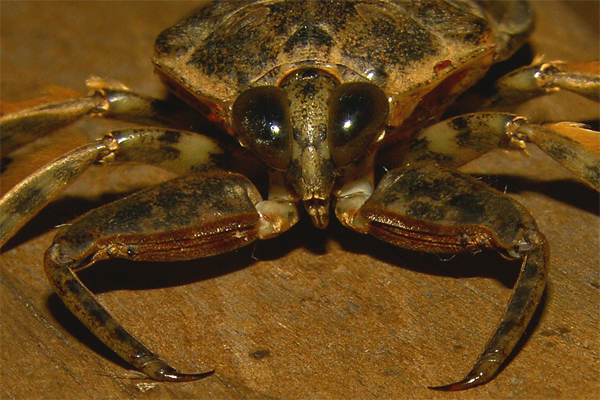
Last night a water bug was added to the list.
This huge bug, in the truest sense of the word, was around 10cm.
I believe it to be Lethocerus Indicus from the Wikipedia discription.

 A quick look at this guy and you can see it is an insect not to be messed with.
Wikipedia states:
"Their bite is considered one of the most painful that can be inflicted by any insect (the Schmidt Sting Pain Index excludes insects other than Hymenoptera); the longer the bug is allowed to inject its saliva, the worse the resulting bite, and as the saliva liquefies muscle tissue"
These macro shots were unnerving at such close proximity.

It was interesting to see parasites infesting the creature (above).
In some species the female lays eggs of the males back, though I believe this to be of a species that cares for its young, inasmuch as hydrating the eggs until they hatch.


With all the insect action going on at the moment, one wonders what next.

Wednesday, February 02, 2011

A burst of hot weather heats it up

A burst of hot, dry weather has seen the veranda getting more use in the early evenings as things cool down, though space is limited as more and more insects vie for a place to meet under the glow of electric lights.

This dragon fly stopped by for a visit,

as did this cicada.
                                    

Beetles of all shapes and sizes abound in whirring confusion, with the odd Christmas beetle still in attendance as well.


 The increased action has not escaped the eyes of predators either.
This huntsman keeps an eye on the proceedings.


Green spotted tree frogs have been around for the last few months and don't miss too many opportunities for a meal as they deftly climb the walls. 


Evenings are a busy place on the veranda, with sitting under the lights just not a comfortable option.
The show that is put on each and every twilight makes it an interesting place nonetheless.

Monday, January 17, 2011

Aerobatic Arachnids

With all the rain we have had over the past few months insect numbers have increased dramatically.
A large swamp that connects to a lake system nearby has been supplying its fair share of mosquitoes and sandflies.
Its no wonder that I have such appreciation of spiders.
This little orb weaver is one of many that has made its residence on my veranda.  

As a child I watched with endless fascination as they formed their webs with such precision and balance, even when gusts of wind would blow them on a tangent temporarily.

Hooks on the hindmost legs help place the web as it is drawn from the spinnerets.

One of the most rewarding aspects of nature is that, no matter how often you have seen something, a new insight can be gleaned. Often when you least expect it. 

 The photo below is a crop of the one above and shows something unusual.
There seems to be a second thread of silk merging with the first to form the strand.
Spiders often have two types of spinnerets.
One is for the web and is fine and strong, the other is for encasing prey and is multi- threaded.
A perfect example is the Saint Andrews Cross.
I was not aware that multiple spinnerets were used for web production, though a number of shots taken indicate two at least.
Some shots of active web spinning spinnerets may prove an enlightening continuation of a study found pleasurable for the past 40 years.

Friday, December 17, 2010

Summer Storms

 With the summer warming rainfall has been at record levels all over the eastern states of Australia.
On Wednesday night at around 8Pm a huge rolling front passed over South Eastern NSW.
Approaching at about 40Km/h, it could be heard when still 5Km away like a jet engine as  hail and torrential rain fell at the lip of formation.
The Photo below has no colour adjustment and was taken minutes before its arrival.
Needless to say the cloud was extremely charged and produced a number 
of huge lightning strikes and sheets  that spanned the sky.
The photo below reminds me of a shot I've seen showing the discharge of electricity 
in a charged plastic sheet. Those who have seen such a  shot will notice the similarity.
The charge is passing over to another cloud, and not to the ground, balancing with the potential at the seaboard.

The aftermath saw hail at a maximum of around 1 cm, with the shot below 
giving an idea of the gusting strength.
The mist is not a dirty lens :) it lay directly behind the front and was heavily charged 
also producing continuous flashing in the sky.


All in all one of the most violent storms I have experienced.
Being a bit of a storm chaser, it was nice to bring the work home for a change.
I was made aware recently that storms, worldwide, are becoming more charged as time progresses.
I would not be surprised if this was linked to increased solar output and interactions 
of charged with the magnetosphere .
A study on the regularity and intensity of Northern/Southern lights
 in relation to lightning activity could be interesting.
This link on the magnetosphere makes an interesting read also.
26.10.10
This link has a interesting study on Solar flares and interactions with the Troposphere.

Friday, December 03, 2010

The rain continues

 A good amount of rain has fallen in our area since late November.
Last night it was accompanied by unusual lightning in the form of "bursts" within the clouds that seemed quite limited in area lit though very charged.
Strong wind gusts accompanied this storm and it was this wind that afforded me the following two shots.
They are of a hive of European Bees that were living within a hollow branch.
Although the weather was still quite cool, there were 100 or so "sentries" keeping a cloud around the immediate area. 
I am trying to get the swarm collected by resident apiarists and have yet to get a reply at the time of this post..


The last two weeks have been damp enough to allow the emergence of  fungi, some of which I have pictured below.
This lovely yellow bracket type is quite small and was growing from an old wagon wheel.


 Immediately above is a type of Puff Ball measuring around 3cm diameter.

The cup like fungi pictured below I have seen in the rain forests of the Southern Highlands, though was a new find for me here on the far south coast.


These small Puff Balls started brownish, though quickly went orange, as in the next shot, deflating as the slightest sunlight and warmth approached.

Monday, November 22, 2010

Dedication to Orchids

There are mere mortals and then there are those who breed Orchids,
showing Dedication and care for the chance of viable seed and a new variety.
These plants are just a few of the impressive collection once owned by Dr Seaton.
His passion for these exotic plants saw many new varieties emerge.
Sadly, at his passing, many of the names of the varieties he produced have been lost.
Orchids everywhere have had a great flowing season, the plant pictured immediately below having flowered for the first time for its new guardian.
  

Wishing Denis Wilson, an Orchid Enthusiast, a very Happy Birthday.
Without your introduction to this wonderful plant, they would remain just a flower.

Monday, November 15, 2010

Spring Storms

The passage of Spring into summer has provided some great electrical storms to photograph this year.
This front passed through last week, with the photo below showing  its intensity after a hot day.


This still from a video of the storm shows the ferocity of the electrical discharges.


The storm passed and indicated another clear day tomorrow.
Many I have talked too feel these events to be more like weather patterns observed at this time 
of year some 25- 30 years ago.


Reptiles are out of hibernation and the first cicada have been heard.
Whether we get a hot summer or a cool one, a wet or a dry one is still up for grabs.
Either way the garden is loving it and so, sadly, is the lawn.

Friday, October 15, 2010

Stars in their eyes

Well today is Blog Action Day again.
This year the subject is water and a worthwhile subject indeed.
Scientists have stated that liquid water is one of the vital ingredients for life on other worlds and, one imagines, the continuance of life here.
Yet much of humanity gets little or none, with the few who have it doing lots of squandering and misusing.
The great Artesian Basin is a perfect example of misusing a limited resource.
With open cut Uranium mines planned for WA, SA and NT, more water than ever will be pumped from the basin in an attempt to slow down the radioactive dust that will blow with westerlies over the eastern states.
You can find out more by watching David Bradbury's recent film for the ETU starring Austen Tayshus "When the dust settles".
Though that is another story that you can catch here:
http://www.andrew-melville-smith.com.au/Videos/whenthedustsettl.html

This blog subject looks a little into the past, just before the space race.
After the conclusion of WW2, as things were getting back to normality, the US wanted to bestow a gift on humanity. They had just saved the world (again) and were feeling powerful and benevolent.
Many ideas were proposed and, amongst the many, one shone out as a great humanitarian act.
It was proposed that water should be in good supply for those who had little or none, with the third world squarely in their sights.
Many great projects were conceived that would supply this precious resource to those in need.
Sadly those great works were never carried out, as it was deemed a project that would neither capture the public imagination nor get the sort of worldwide prestige that a working space organisation would.
So, with heads raised and gazing skyward, we moved forward into an age where the haves had more and the have-nots had less and less.
Don't misunderstand me, great things have come from those endeavors with greater things yet to come.
We stand on the brink of something big.
We wont get there until we are united.
This doesn't have to mean a world government. It can be as simple as making sure we all have enough food and water and showing that we are all on one team.
It is doable. It is also necessary so that we might take the next step.
Lets clean up the house before we go out.
Time to get things in order here.
Lets start with good drinking water for all.
Then lets consider the root issue. A sustainable world population.

Stephan Pastis " Pearls Before Swine


Petitions by Change.org|Start a Petition »


Saturday, October 09, 2010

Feeding The Rays

Its been a long time since I visited Bendalong and was glad to see that over 25 years large black rays are still coming in for a feed.
I last experienced this phenomenon with my Daughter Rhiannon, some 8 years ago,and was happy to see that it has not gone the way various Dolphin and Penguin visitations have.
It remains an encounter.
Having said that, lets try to keep it that way.
It is true to say that encounters with large black Rays are common around many boat ramps along the southern NSW coastline, though I find the greeting at Bendalong the most rewarding.
This Video is of some of that day and I have tied to capture the experience in going face to face with a large and alien being.
I bought some Pilchards to wave in the water so a to attract a few Rays, though it is debatable if the Pilchards played a part at all. I noticed if you stamped your foot in the sand under water they came more readily.
They are brought in by the fishing boats, presumably called by the thump of the engines. Perhaps we are associated with low wave concussive sound-forms, food being a reward to tolerate incessant patting.
The eyes of this creature will survey you from above the waterline, just to get good look, and will spot a floating pilchard go by as you will see.
My mate Marvin bravely went face to face for the vid.
This was of no great risk. Rays are gentle, though potentially dangerous, creatures.
Just as with a horse, you keep distance of the back end.


A fitting post for the 4Th anniversary of this blog.
Thank you again all those who show your interest in my interests.
Change.org|Start Petition

Friday, September 10, 2010

Ant Power

When in Northern Queensland I was able to get shots of some very interesting creatures.
These Green Ants are building a nest.
By using brut strength and numbers they curl the leaves and fix them with excretions.
The resultant nest is waterproof and strong.
Although they have a nasty bite, they are quite tolerant - which is good, as they are found in vast numbers throughout rainforest areas.

Saturday, August 28, 2010

A feast of forms

After traveling over 7000Km up to Cape Tribulation on the Queensland North Coast and back over the last month, I was able to collect a variety of creatures some of which are shown below.
This Star Fish was shot at Arlie beach, surfacing from the sand with the influx of the tide.


These birds inhabit the far north in profusion and nest overnight in the branches overnight.
Unafraid of people, they scour the campsites for morsels without fear.

Salt Water Crocs prowl the waters, this specimen over 3 metres in length and over 70 years old.

This Rino Beetle was quite big and aggressive, having bit my finger whilst I attempted to photograph it.

Preying Mantis were in abundance, and as curious as ever.

This Manta Ray was off the beach at Fraser Island, crusing the shallows for crabs.

Kookaburras provided a loud waking call in the early morning chorus.

A Kadadid hunts at night.

This Jeweled Spider was a long way north of those I photographed years back in the Southern Highlands of NSW.
Honey eaters were many and varied.


The Goanna seen in Queensland were smaller than their southern relatives

This Gecko was out for the hunt one night for moths at Wonga Beach near Daintree Rainforest.

Fraser Island had many species of fish, these captured in shallow waters of the Champagne Pools on Fraser Island.

Dingos also prowl the Island, and are to be walked warily amongst.

This unusual bird was photographed Near Emerald Qld.

A Fascinating Holiday with many shots taken of scenery and wildlife in abundance.
I hope to post more as they are processed.