Thursday, October 20, 2011

Montague Island

Yesterday I had the chance to get a tour of Montague Island and its surrounds.
Many thanks to my mate Grahame from Bermagui Eco Tours for the trip.
( you can contact him on grahame@headhuntercharters.com.au)
Montague Island is an interesting spot consisting of natural and historical heritage areas.

Below is a colony of Arctic Turns.


There are also many Fairy Penguins on the Island.
This one is returning to its nest in the evening.


These Seagulls are announcing the return of the Penguins and swarm the area above the water.


The Island has a large Seal colony, with much of the area surrounding the Island being part of  a marine Park.

The Island also has very interesting Basalt and Granite outcropping, with the distribution of the Basalt on the Northern side and Granite to the South, with the Granite used to build a lighthouse in the late 1880's.
The following view is to the North from the lighthouse, with the Southern view unpublished due to the presence of significant Aboriginal heritage sites.


It is possible to stay on the Island - contact Narooma Tourism Association for further details.
Thanks to my mates from National Parks and Wildlife for making the stay so enjoyable.


Sunday, October 16, 2011

Blog Action Day 2011


This Blog Action Day is all about food.
This video was shot in 2007 and demonstrates that while much of the world goes hungry, much food goes to waste to maintain purchasing structures within large supermarket chains.
When the human factor becomes the priority in capitalism, and it is realised that you make more money in a stable world, perhaps this situation will change.
Apologies for the low resolution.
It was important that it loaded quickly, so you would see it entirety.
.......................................

Sunday, October 02, 2011

Out on an excursion

The Duck family was out on an excursion today at our place.
Charlie the Red Cattle Dog watched on as the matriarch of the posse led the group through our yard, showing all the good spots, then out through the fence and back for a swim.

Many water birds have well developed chicks, and are out showing them the ropes as they gain size and confidence.


Saturday, October 01, 2011

Good rain this Spring

Regular cold fronts over NSW have supplied steady rainfall so far this Spring.
This isolated storm system passed through a starry sky last night producing some phenomenal lightning strikes such as the one pictured below.

Early and sustained Spring rains have been responsible for many Summer bushfires, due to the accelerated undergrowth providing fuel that dries out over summer making a hot burn more likely.
These small individual events are highly charged with spectacular  displays as they approach the coast ahead of the main front.

Tuesday, September 27, 2011

Spring has Sprung

Although some nights are still a little cold, Spring has established itself at last with increased insect life - being a good sign that the trend will continue into summer.
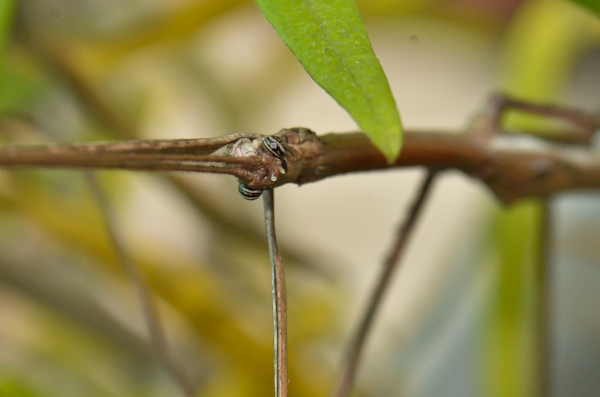
The early arrivals have begun to make themselves more apparent, one of them the Stick Insect.
This specimen was around 30cm long.


It was great to get a good shot of the most unusual mouth structure of this insect - one that works like a pair of sideways angled snips as the creature trims away at the leaves


Tiny Orb Weaver Spiders have begun to appear, as have a variety of caterpillars.
Im looking forward to photographing them with the new equipment purchased this last winter, with the aim to reveal new insights into their construction and behaviour.

Thursday, September 22, 2011

Morning Dive

This morning was great for a dive, so I dragged out the wetsuit and braved the cold water so as to give the camera a run.
First off I came across a huge Octopus.
They are very curious and intelligent animals, and it was all I could do to keep the camera and keep a little distance from a creature that, once it latched on to you, would be very hard to remove.
Octopus have a "beak" much like a parrot and can remove a large chunk of skin when they are as large as this one was.
Amongst the sea grasses and in rock crevasses are, at the moment, Lobsters.
The water is still very cool and soon, as the water warms, they will leave the coast for their long walk to the continental shelf where they will stay till next winter.
This lobster in this footage was unlucky enough to be large enough to keep, and will make a nice dinner.


Hopefully the seas stay flat and I can shoot some more footage soon...hopefully of more Lobsters.

Sunday, August 28, 2011

Echidna and Hitch-hiker

Things have warmed up enough for Echidna to begin getting about.
As this guy made a dash to ground I was able to snap a shot or two, be it with the wide angle lens I had attached at the time - not really up to the task for this sort of work, and noticed a couple of hitch-hikers.

Now you may ask what sort of  incredibly game critter would hitch on the back of an Echidna, well a rather small and potentially dangerous one - the Blue Paralysis Tick.

While probably not too much hassle to the Echidna, for humans its a whole different story.
These little-fingernail sized ticks have been known to kill many a domestic pet and cause illness in humans.
Im not sure if anyone has died from these ticks, though I wouldn't doubt it was possible.
Just another sign that Spring is just about here and that the critters are awakening.

Monday, August 15, 2011

White Sea Eagle chicks

A stand of dead trees with a view has been the hangout of a couple of White Sea Eagle chicks from last breeding season.
Still covered in their brown plumage, these adolescent birds have been combing the area for small rodents in the surrounding fields.


With nesting already begun this year for adult birds, the numbers of these great hunters have increased in this area due to a plentiful food supply ranging from small rodents to full grown Fairy Penguin.

Monday, August 01, 2011

My cheeky friend

It only takes a little kindness to make a friend.
Sometimes that friend can take things for granted.
Its always ok when your somewhat cheeky friend is a butcher Bird.


While I'm not into feeding masses of birds - its not good practice, for it provides an unstable food source that, if discontinued, can cause all sorts of problems - I make exception for this guy.
The Butcher Bird is a member of the Kingfisher family and will readily make itself part of your family, given enough encouragement which, by the way, is very little.
After returning from fishing with my hard earned catch, this guy promptly tried to snatch a fish more than twice his size as I was cleaning them.
The photo below shows him demonstrating that he can indeed catch his own meal. 
A point he made when I was a little slow in providing food for him.
You will notice the colouration of yellows and blues under his wings and on his body.
This is not readily evident, though can be seen with correct lighting (and luck).


Yes, a not exactly patient, though worthwhile, friend to make..


Monday, July 18, 2011

Are Koalas the issue?

South Eastern forests have been subject to logging and their fair share of protesters over the last few weeks.
This is nothing new, due to the nice stands of spotted gum located in state forest areas down this way.

The protesters main thrust against this logging is that habitat for koala is being lost.
Forestry workers I talked to today stated that they had done extensive surveying of the area and have found none, though protesters state that these areas are, in the least, safe areas for migration during times of drought, fire or other environmental factors that would drive them from established, and universally recognised, areas of habitation.


Now, here's the real spanner in the works..both groups are missing the big picture. yep.
At another time the logging was on, in a slightly different area,
I was able to observe what actually happens in there.
Yes, someone removed some signs on a track...you know, the ones that say things similar to :
" do not enter under pain of death".
I wish they hadn't. I don't like to be where I'm not supposed to be,
also I had real difficulty getting out in my 4X4.
So, what did I see that Im not supposed to?
Well, the track was churned up to over 300mm of fine dust, as was the surrounding "forest"
and, at points, was much worse than that.
No plant was to be seen at ground level and the few trees left were scarred by machinery,
weak and small and very well spaced apart.
Ok, so now we get to the main reason, in my mind, why this action should halt.
It has nothing to do with the senseless rape of the forest, or furry koalas going hungry...its about erosion.
Its about cubic tonnes of topsoil running into creeks that lead to lakes...many with protected areas of habitat.
Last time this logging went on we had large amounts of rain soon after,
and soon after that I went fishing in Wallaga Lake.
I didn't catch any fish...probably because of the extensive amount of fine particulate saturating the water that, strangely enough, was the same colour as the soil I'd seen on that unplanned drive through devastation some weeks earlier. I suppose the floating grass and plant debris was the clincher.
Here's the latest "Pain of death" sign.
Yep, When advised of course I'll stay out :)

And here is where its going on at the moment, upstream from Wallaga Lake.


This picture ,below, is a protected habitat and an upper arm of Wallaga Lake.
It is also downstream of current logging operations.
...and an ok place to be ( at the moment anyway).

Yes, since I have lived in this area Wallaga lake has silted up... quite a bit over the last 4 years .
Koalas or not, the big picture is much bigger than you knew.
The logging IS upstream of Wallaga Lake.

Much more is at risk.
If destruction of environment and protected habitats disturbs you, you can email the Minister for Sustainability, Environment, Water, Population and Communities, Mr Tony Burke at:
tony.burke@environment.gov.au
If you live in another part of the world, I'm sure Mr Burke would still like to hear from you.
You never know, you might want to visit our still beautiful and diverse part of it one day.

Wednesday, July 06, 2011

A glimpse of a European summer

While in Germany this visit, I did not have much opportunity to get a lot of nature shots.
My lens was turned towards architecture and landscape this time.
You can see the results of that endeavour on my Facebook site.
(There is a link on the left hand side of this post)
I did glimpse a moment or two, such as these pictured below.

Firstly, a large land snail laying its eggs.
At just under 50mm across the shell, its eggs were just under pea sized objects.
 Then there was this strange critter.
I am yet to identify it, though I saw empty shells left behind once it had metamorphosed.
Into what, I'm yet to determine also.  


This was a little easier to ID.
It is, of course, a hedgehog.
Sadly I wasn't able to photograph a family, which makes a rather cute photo I'm told.
 I was able to capture this Hover Fly laying eggs though.


As well as these snails in the act of hermaphroditic reproduction

I was amazed at the number and range of small insects I had never encountered before.
So much so, I would like to thank Bridget and Ralph for he identification book they gave me.
Still looking for this one.

This is definitely an ant.


I was not aware that Hover Flies eat pollen, though they do.

Some things are constant though, such as the beetle attacks experienced over the summer months.
Just before dark, for about half an hour, masses of small beetles crowd the air.

They gather in ever growing clusters until the mass of the group is too much and they fall to the ground, only to resume this behaviour again.
Soon they are gone for the night, around the time bats come out and begin the hunt for them.
A most interesting spectacle indeed.