The East coast of Australia has had some severe storms of late.
This video shows the extent of the sea foam washed ashore.
Its maximum depth was a little over 2 meters and was positioned over sand on the beach above the waterline.
Its a strange sensation being encased in a sea of windblown foam, with an idea of what it would be like pictured below. Keep in mind that we are standing on dry beach. :)
Monday, March 28, 2011
Monday, March 07, 2011
Fellow nature lovers
I would like to thank Jasmine Hall from onlineclasses.org for sending me some great links under the heading " 12 coolest TED talks for nature lovers".
The talks are well worth viewing and so I have decided to include them for your enjoyment.
Below is a sample of what the link has to offer.
The following video is from a talk on Bees by Dennis vanEngelsdorp and makes compelling viewing.
Saturday, March 05, 2011
Stick Insect
Today I was lucky enough to photograph a reasonably large Stick Insect.
They seemed fairly common when I was younger, not so now.
Perhaps I spent more time looking. :)
It was interesting to note the vertically arranged mouth parts, enabling easy shredding of leaves.
The plant being consumed is a Black Wattle
Having never seen a Stick Insect feeding, this was a great photographic opportunity for me to capture one of natures more interesting and unusual forms in its day to day activities.
Tuesday, February 15, 2011
Aussie Bull Ant
Most bushwalking Australians have encountered this ant.
Those who have had previous dealings with it tend keep their distance.
Of the genus Myrmecia, there are over 90 species ( and counting) of this insect.
The sting is painful and is a follow up to being grabbed by legs and those fearsome jaws.
Other than the Water Bug, one of my most cautious macros to date.
More information on bull ants can be found here.
Sunday, February 13, 2011
Hidden Munchers
A wet late Spring and Summer has been perfect for the growing of corn.
While not really practical from a home garden point of view, it gives kids insights that are more valuable than the resultant crop itself.
Our 3m x 2m plot came to fruition recently and so we began harvest, only to find someone had started the harvest without us.
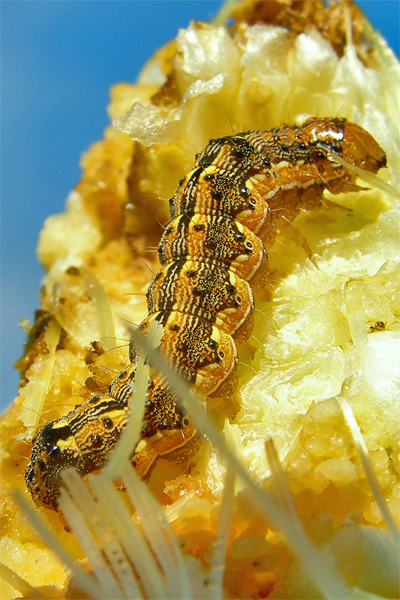
Known by many names, due to the variety of crops on which it feeds, Helicoverpa armigera ( family Noctuidae), is considered a pest worldwide.
Pics of the the adult moth can be found here.
The above specimen is considered adult, in its grub stage, being brown in colour, while the specimen below shows its juvenile status by its green colouration.
Despite being considered a pest, the markings of this creature are exquisite.
Im not sure if these millipedes were responsible for this area of consumption, or whether they took advantage of an opening to construct their home.
Much corn was harvested, with much of it still good.
The amount shared with these insects was negligible and the encounter was quite educational.
Friday, February 04, 2011
Veranda saga continues - The giant water bug
The list of visitors to my veranda keeps growing.
Last night a water bug was added to the list.
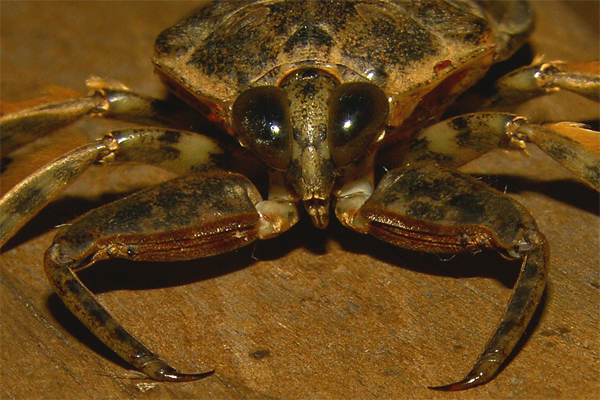
This huge bug, in the truest sense of the word, was around 10cm.
I believe it to be Lethocerus Indicus from the Wikipedia discription.
A quick look at this guy and you can see it is an insect not to be messed with.
Wikipedia states:
"Their bite is considered one of the most painful that can be inflicted by any insect (the Schmidt Sting Pain Index excludes insects other than Hymenoptera); the longer the bug is allowed to inject its saliva, the worse the resulting bite, and as the saliva liquefies muscle tissue"
These macro shots were unnerving at such close proximity.
It was interesting to see parasites infesting the creature (above).
In some species the female lays eggs of the males back, though I believe this to be of a species that cares for its young, inasmuch as hydrating the eggs until they hatch.
With all the insect action going on at the moment, one wonders what next.
Wednesday, February 02, 2011
A burst of hot weather heats it up
A burst of hot, dry weather has seen the veranda getting more use in the early evenings as things cool down, though space is limited as more and more insects vie for a place to meet under the glow of electric lights.
This dragon fly stopped by for a visit,
as did this cicada.
Beetles of all shapes and sizes abound in whirring confusion, with the odd Christmas beetle still in attendance as well.
The increased action has not escaped the eyes of predators either.
This huntsman keeps an eye on the proceedings.
Green spotted tree frogs have been around for the last few months and don't miss too many opportunities for a meal as they deftly climb the walls.
Evenings are a busy place on the veranda, with sitting under the lights just not a comfortable option.
The show that is put on each and every twilight makes it an interesting place nonetheless.
Labels:
cicada,
dragonfly,
green spotted treefrog,
huntsman spider
Monday, January 17, 2011
Aerobatic Arachnids
With all the rain we have had over the past few months insect numbers have increased dramatically.
A large swamp that connects to a lake system nearby has been supplying its fair share of mosquitoes and sandflies.
Its no wonder that I have such appreciation of spiders.
This little orb weaver is one of many that has made its residence on my veranda.
As a child I watched with endless fascination as they formed their webs with such precision and balance, even when gusts of wind would blow them on a tangent temporarily.
Hooks on the hindmost legs help place the web as it is drawn from the spinnerets.
One of the most rewarding aspects of nature is that, no matter how often you have seen something, a new insight can be gleaned. Often when you least expect it.
The photo below is a crop of the one above and shows something unusual.
There seems to be a second thread of silk merging with the first to form the strand.
Spiders often have two types of spinnerets.
One is for the web and is fine and strong, the other is for encasing prey and is multi- threaded.
A perfect example is the Saint Andrews Cross.
I was not aware that multiple spinnerets were used for web production, though a number of shots taken indicate two at least.
Some shots of active web spinning spinnerets may prove an enlightening continuation of a study found pleasurable for the past 40 years.
Friday, December 17, 2010
Summer Storms
With the summer warming rainfall has been at record levels all over the eastern states of Australia.
On Wednesday night at around 8Pm a huge rolling front passed over South Eastern NSW.
Approaching at about 40Km/h, it could be heard when still 5Km away like a jet engine as hail and torrential rain fell at the lip of formation.
The Photo below has no colour adjustment and was taken minutes before its arrival.

On Wednesday night at around 8Pm a huge rolling front passed over South Eastern NSW.
Approaching at about 40Km/h, it could be heard when still 5Km away like a jet engine as hail and torrential rain fell at the lip of formation.
The Photo below has no colour adjustment and was taken minutes before its arrival.
Needless to say the cloud was extremely charged and produced a number
of huge lightning strikes and sheets that spanned the sky.
The photo below reminds me of a shot I've seen showing the discharge of electricity
in a charged plastic sheet. Those who have seen such a shot will notice the similarity.
The charge is passing over to another cloud, and not to the ground, balancing with the potential at the seaboard.
The aftermath saw hail at a maximum of around 1 cm, with the shot below
giving an idea of the gusting strength.
The mist is not a dirty lens :) it lay directly behind the front and was heavily charged
also producing continuous flashing in the sky.

All in all one of the most violent storms I have experienced.
Being a bit of a storm chaser, it was nice to bring the work home for a change.
I was made aware recently that storms, worldwide, are becoming more charged as time progresses.
I would not be surprised if this was linked to increased solar output and interactions
of charged with the magnetosphere .
A study on the regularity and intensity of Northern/Southern lights
in relation to lightning activity could be interesting.
This link on the magnetosphere makes an interesting read also.
26.10.10
This link has a interesting study on Solar flares and interactions with the Troposphere.
Friday, December 03, 2010
The rain continues
A good amount of rain has fallen in our area since late November.
Last night it was accompanied by unusual lightning in the form of "bursts" within the clouds that seemed quite limited in area lit though very charged.
Strong wind gusts accompanied this storm and it was this wind that afforded me the following two shots.
They are of a hive of European Bees that were living within a hollow branch.
Although the weather was still quite cool, there were 100 or so "sentries" keeping a cloud around the immediate area.
I am trying to get the swarm collected by resident apiarists and have yet to get a reply at the time of this post..
The last two weeks have been damp enough to allow the emergence of fungi, some of which I have pictured below.
This lovely yellow bracket type is quite small and was growing from an old wagon wheel.
Immediately above is a type of Puff Ball measuring around 3cm diameter.
The cup like fungi pictured below I have seen in the rain forests of the Southern Highlands, though was a new find for me here on the far south coast.
These small Puff Balls started brownish, though quickly went orange, as in the next shot, deflating as the slightest sunlight and warmth approached.
Monday, November 22, 2010
Dedication to Orchids
There are mere mortals and then there are those who breed Orchids,
showing Dedication and care for the chance of viable seed and a new variety.
These plants are just a few of the impressive collection once owned by Dr Seaton.
His passion for these exotic plants saw many new varieties emerge.
Sadly, at his passing, many of the names of the varieties he produced have been lost.
Orchids everywhere have had a great flowing season, the plant pictured immediately below having flowered for the first time for its new guardian.
Wishing Denis Wilson, an Orchid Enthusiast, a very Happy Birthday.
Without your introduction to this wonderful plant, they would remain just a flower.
Subscribe to:
Posts (Atom)