Monday, April 25, 2011

Time-lapse Stream

As a nature photographer its often difficult to capture a new perspective on something that has been shot a thousand times before.
It is that new perspective that allows new insights.
Such is the video I have posted below.
Although time lapse photography and extended exposures are nothing new, It is the melding of these techniques in new ways that allow the of viewing nature in a whole new way.
This, I believe, I have accomplished here for the first time for the classic waterfall shot.


I hope you enjoy this piece of footage and the new perspective it affords.

Wednesday, April 20, 2011

Colony

I was able to photograph an insect exodus, as a number of winged queen ants and their followers made for new territory the other day.
Sporting a new macro attachment, I took the following shots of these insanely small subjects.


Notice the winged worker, behind the queen, in the above shot.
Strangely enough there were very few, though I saw four winged queen ants.


The whole process of the departure was quite insistent, as the non winged ants coaxed those leaving with mandibles gently nipping . 
The whole nest seemed to be out for the occasion, the ground alive with these small black ants.

Monday, April 18, 2011

Trip to Mimosa Rocks

A quick trip to Mimosa Rocks today was very rewarding, with a couple of great shots and the meeting of some very interesting people - from archivists and German tourists to lighting specialists.
I have included the following shot for my Lighting specialist friend :)
Following our discussion on Germany it is, of course, Berlin Hauptbahnhof.
I've included a link here for those who would like to know a little more about this fascinating building.


It seems that there has been some strange raising of the stones at Mimosa.
This I was able to capture, as seen below.

Yes, a little arty and mystical in black and white.
There were rings of such standing stones and constructions reminiscent of Easter Island statues gazing out to sea..be it all miniature in comparison to the aforementioned.

With all the excitement, I was still able to get a nice little shot of some wildlife as well.

I believe them to be Scrub Wrens, the male in the foreground.

All in all a most interesting morning.


Sunday, April 17, 2011

High speed action

At breakneck speed the Welcome Swallows are collecting the last of the insects available before the oncoming cool weather.
Shooting at 1/6400 of a second at an ISO of 6400 is barely fast enough to catch the action as they dive from power lines towards a nearby dam to skim the surface.

Aerobatics a jet fighter pilot would envy, I found photographing the Welcome Swallow in action is quite a challenge. 


Saturday, April 16, 2011

Autumn Harvest

With the onset of colder weather bird life of all sorts has been taking advantage  of the still plentiful insect population.
When cutting the lawn the other day I was amazed how many wolf and grass spiders I disturbed.
This little guy was a little nervous of my macro.

Out in the surrounding fields the spider population is such that these Heron were catching a spider a minute in the long grass .

Mice are also plentiful and keep us busy blocking the ingress points they keep finding; my snake "mittens" driven insane by the scent trails that are painfully obvious to him in his pre winter feed mode.
Its all part of living in an area laden with wildlife though.
I'm looking forward to catching up again with naturalist Denis Wilson over the next week to study the local forest and should have some interesting posts on that distinctive environment to follow soon.

Monday, March 28, 2011

Extreme Sea Foam

The East coast of Australia has had some severe storms of late.
This video shows the extent of the sea foam washed ashore.
Its maximum depth was a little over 2 meters and was positioned over sand on the beach above the waterline.

Its a strange sensation being encased in a sea of windblown foam, with an idea of what it would be like pictured below. Keep in mind that we are standing on dry beach. :)

Monday, March 07, 2011

Fellow nature lovers

I would like to thank Jasmine Hall from onlineclasses.org for sending me some great links under the heading " 12 coolest  TED talks for nature lovers".
The talks are well worth viewing and so I have decided to include them for your enjoyment.
Below is a sample of what the link has to offer. 
The following video is from a talk on Bees by Dennis vanEngelsdorp and makes compelling viewing.


Saturday, March 05, 2011

Stick Insect

Today I was lucky enough to photograph a reasonably large Stick Insect.
They seemed fairly common when I was younger, not so now.
Perhaps I spent more time looking. :)
It was interesting to note the vertically arranged mouth parts, enabling easy shredding of leaves.
The plant being consumed is a Black Wattle 


Having never seen a Stick Insect feeding, this was a great photographic opportunity for me to capture one of natures more interesting and unusual forms in its day to day activities.

Tuesday, February 15, 2011

Aussie Bull Ant

Most bushwalking Australians have encountered this ant.
Those who have had previous dealings with it tend keep their distance.

Of the genus Myrmecia, there are over 90 species ( and counting) of this insect.
The sting is painful and is a follow up to being grabbed by legs and those fearsome jaws.
Other than the Water Bug, one of my most cautious macros to date.
More information on bull ants can be found here.

Sunday, February 13, 2011

Hidden Munchers

A wet late Spring and Summer has been perfect for the growing of corn.
While not really practical from a home garden point of view, it gives kids insights that are more valuable than the resultant crop itself.
Our 3m x 2m plot came to fruition recently and so we began harvest, only to find someone had started the harvest without us.
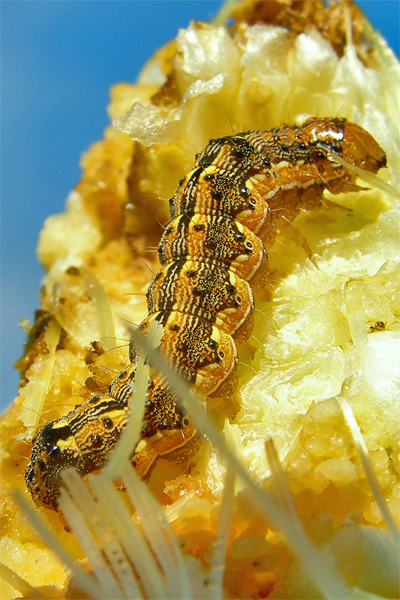
Known by many names, due to the variety of crops on which it feeds, Helicoverpa armigera ( family Noctuidae), is considered a pest worldwide.
Pics of the the adult moth can be found here.

The above specimen is considered adult, in its grub stage, being brown in colour, while the specimen below shows its juvenile status by its green colouration.


Despite being considered a pest, the markings of this creature are exquisite.

Im not sure if these millipedes were responsible for this area of consumption, or whether they took advantage of an opening to construct their home. 


Much corn was harvested, with much of it still good.
The amount shared with these insects was negligible and the encounter was quite educational. 

Friday, February 04, 2011

Veranda saga continues - The giant water bug

The list of visitors to my veranda keeps growing.
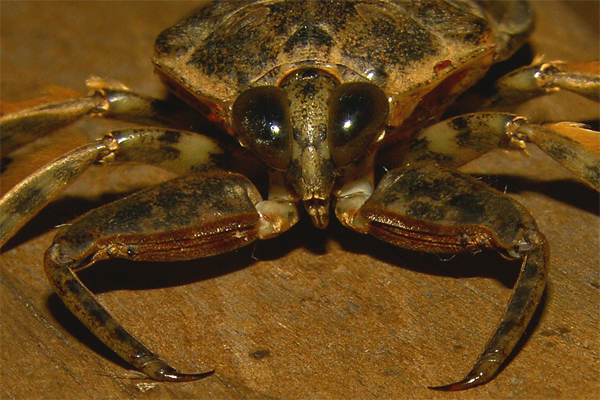
Last night a water bug was added to the list.
This huge bug, in the truest sense of the word, was around 10cm.
I believe it to be Lethocerus Indicus from the Wikipedia discription.

 A quick look at this guy and you can see it is an insect not to be messed with.
Wikipedia states:
"Their bite is considered one of the most painful that can be inflicted by any insect (the Schmidt Sting Pain Index excludes insects other than Hymenoptera); the longer the bug is allowed to inject its saliva, the worse the resulting bite, and as the saliva liquefies muscle tissue"
These macro shots were unnerving at such close proximity.

It was interesting to see parasites infesting the creature (above).
In some species the female lays eggs of the males back, though I believe this to be of a species that cares for its young, inasmuch as hydrating the eggs until they hatch.


With all the insect action going on at the moment, one wonders what next.